
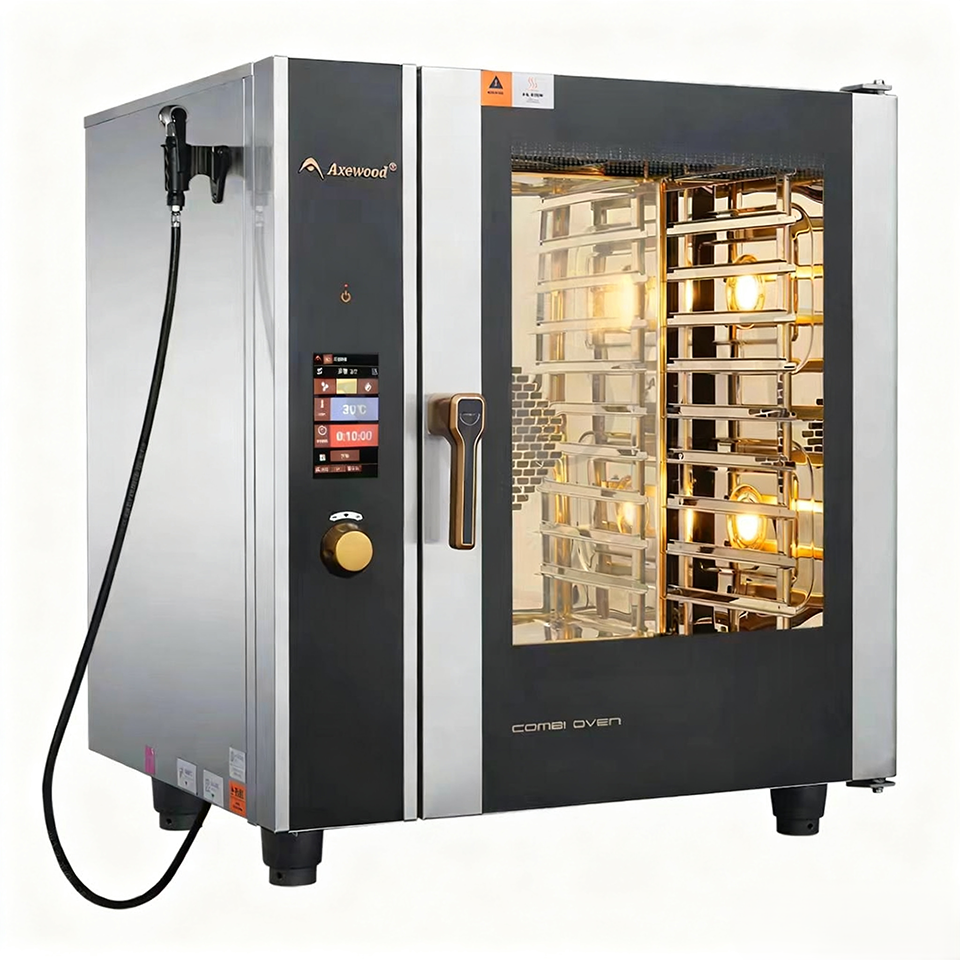
A 2026 buyer's guide to 10 GN commercial combi steam ovens: tray capacity, steam percentage 10-100%, temperature accuracy plus or minus 1 degree C, hot-air fan 50-110%, and FAT records to verify before shipment.
Shunxiang Central Kitchen supplies commercial combi steam ovens and food processing equipment for central kitchens, prepared food plants, and export catering projects that need real steam, real hot air, and repeatable menu output. For an export buyer in 2026, a combi steam oven should not be selected by tray count alone. Steam generation method, hot-air speed range, temperature accuracy, water supply quality, drainage design, and FAT records decide whether the oven can keep menu quality after a sea-freight journey.
I have seen a 10-tray combi oven arrive at a Southeast Asian catering plant with perfect temperature settings, yet fail on the first lunch service. The problem was not the heating element. The plant had 0.4 MPa water pressure and the oven needed 0.2 to 0.5 MPa with a 3/4 inch inlet diameter. The water line was reduced to 1/2 inch, and steam recovery collapsed during peak service. After two weeks of complaints, the operator was not blaming the oven brand. He was blaming the salesperson who did not ask about the water line before shipping.
Main Buyer Question
The real question is: before placing an order for a 10 GN commercial combi steam oven, what should be checked so the oven runs at rated steam percentage, holds plus or minus 1 degree C across a full 30 to 290 degree C working range, and passes FAT records a buyer can actually use?
Key Takeaways
- Effective output for a 10 GN combi oven equals cavity volume times usable steam recovery, not only the tray count on the brochure.
- Steam percentage range usually runs 10 to 100 percent, with a frequency-conversion variable-speed fan delivering 50 to 110 percent air speed for hot-air cooking.
- Temperature accuracy of plus or minus 1 degree C across 30 to 290 degree C matters for ready-to-eat meal centers and hotel buffet lines, where plate quality cannot drift between lunch and dinner.
- Water pressure must be in 0.2 to 0.5 MPa with a 3/4 inch to 1/2 inch inlet diameter; below 0.2 MPa the boiler cannot refill between cycles, above 0.5 MPa the safety valve will open too often.
- Food contact areas should be 304 stainless steel or higher, and the washdown path needs a 42 mm drain pipe with no horizontal trap.
Parameter Table
| Item | Typical Check Point | Why It Matters |
|---|---|---|
| Capacity | 10 x 1/1 GN pans | Defines shift output and menu range |
| Temperature range | 30 to 290 degree C | From low-temperature steam to high-heat roast |
| Temperature accuracy | plus or minus 1 degree C | Plate-to-plate consistency across service |
| Steam percentage | 10 to 100 percent adjustable | Steam-only, hot-air-only, or combi cooking |
| Fan speed | 50 to 110 percent variable speed | Controls browning, crust, and core moisture |
| Heating power | 16 kW | Defines recovery time and circuit load |
| Total power | 16.4 kW | Full-load planning for 3-phase plant rooms |
| Power supply | N-380V AC / 50Hz / 3PH | Must match local plant power and breaker |
| Current and breaker | 25A / 40A breaker | Prevents tripping under continuous duty |
| Water inlet | 3/4 inch to 1/2 inch | Boiler refill speed between batches |
| Water pressure | 0.2 to 0.5 MPa | Steam recovery stability |
| Drain pipe | 42 mm | Washdown and condensate removal |
| Net / gross weight | 132 / 170 kg | Floor loading and lifting plan |
| External dimensions | 935 x 795 x 1100 mm | Floor footprint and clearance for service |
| Cavity entrance | 609 x 734 mm | 1/1 GN pan clearance with margin |
Model Comparison
| Option | Best Fit | Buyer Risk |
|---|---|---|
| 10 GN touchscreen combi oven (AWE-101B-M2) | Catering centers, central kitchens, hotel buffets, ready-meal lines | Confirm water pressure, breaker capacity, and drain layout early |
| 6 GN tabletop combi oven | Small cafes, prep kitchens, satellite stores | Lower output per cycle, not suitable for 200 plus meals per service |
| 20-tray heavy-duty combi oven | Airline catering, hospital kitchens, large banquet halls | Higher power, larger floor area, longer recovery time |
| Standard convection oven (no steam) | Bakery-only or dry roasting lines | Cannot replace a combi oven when steam cooking is required |
Related Hymic Products
This article connects to the 10 GN commercial combi steam oven (AWE-101B-M2, SKU HM-5), the 6 GN touchscreen combi oven (HM-3), and the 20-layer universal steam oven on hymic.com. Buyers should compare tray capacity, steam percentage, total current, drain pipe diameter, and water inlet size before locking a specification.
FAT and Hygiene Checks
During factory acceptance testing, run the combi oven for at least two full steam cycles and one hot-air-only roast cycle. Record steam recovery time from cold start, hold at 95 degree C with 100 percent steam, then shift to 220 degree C with 30 percent steam and 100 percent fan speed. Check temperature stability on a 4-point meat probe and confirm drainage during washdown. For food contact safety, EN 1672-2:2025 gives hygiene requirements for food machinery, and IEC 60350-1 remains the reference for oven heating performance. Buyers in the EU should also verify GB 31654-2021 and local material rules when the oven is destined for export.
Buyer Checklist
- Confirm target output per service in portions or kilograms, not just tray count.
- Verify local power supply (380V three-phase, 50Hz) and breaker capacity (40A minimum).
- Confirm water pressure is between 0.2 and 0.5 MPa, with a 3/4 inch inlet diameter.
- Check the drain pipe layout, slope, and 42 mm diameter before floor installation.
- Plan 150 mm floor clearance on every side for cleaning access and air circulation.
- Request FAT records showing steam recovery, temperature stability, and fan speed curves.
- Order spare door seals, heating elements, water filters, and silicone gaskets with the oven.
- Ask for menu programming training and a remote support channel for the touchscreen controller.
Field Experience: What Usually Goes Wrong
Most combi oven complaints after arrival are not heating failures. They are water supply, drainage, and steam recovery. A 0.1 MPa drop in water pressure will not stop the oven from turning on, but it will cut steam recovery and slow menu cycles. A flat horizontal drain pipe will hold condensate and create back-pressure during washdown. A 1/2 inch inlet on a long pipe run will starve the boiler on back-to-back banquet service. Confirm water and drainage with the same discipline as the power supply, and the oven will run as the brochure says.
FAQ
1. What is the difference between a combi steam oven and a convection oven?
A combi steam oven controls steam percentage from 10 to 100 percent, so the cavity can cook with steam-only, hot-air-only, or combined modes. A standard convection oven only delivers hot air, which cannot match a combi oven for low-temperature steam cooking, moist reheating, or steam-roast finishing.
2. How should buyers decide between 6 GN, 10 GN, and 20 GN capacity?
Decide by portions per service, plate weight, and menu type. A 10 GN oven usually covers 150 to 250 portions daily, which fits central kitchens, hotel buffets, and ready-meal lines. A 6 GN oven fits cafes and prep kitchens. A 20 GN oven fits airline catering and large banquets, but requires more floor area, higher power, and a stronger exhaust hood.
3. Why does water pressure matter so much?
Steam recovery depends on how fast the boiler can refill between cycles. Below 0.2 MPa the boiler cannot keep up during back-to-back banquet service, and steam percentage drops. Above 0.5 MPa the safety valve will open too often. The recommended band is 0.2 to 0.5 MPa with a 3/4 inch inlet, reduced to 1/2 inch close to the oven if needed.
4. Should buyers check FAT records?
Yes. FAT records should include steam recovery time, temperature stability with a 4-point meat probe, fan speed curve, and washdown test. Without these records, a buyer cannot confirm that the oven leaving the factory is the same oven arriving on site.
5. What standards should be mentioned in the combi oven RFQ?
EN 1672-2:2025 for food machinery hygiene, IEC 60350-1 for oven heating performance, and local electrical standards for the destination country. For China-domestic export, GB 31654-2021 and GB 4806.1-2016 are useful references for food contact materials and clean processing.
Final specifications should follow the selected model, project requirements, and supplier technical documents. Buyers can review related combi steam oven and steam oven models on hymic.com before confirming a purchase specification.