
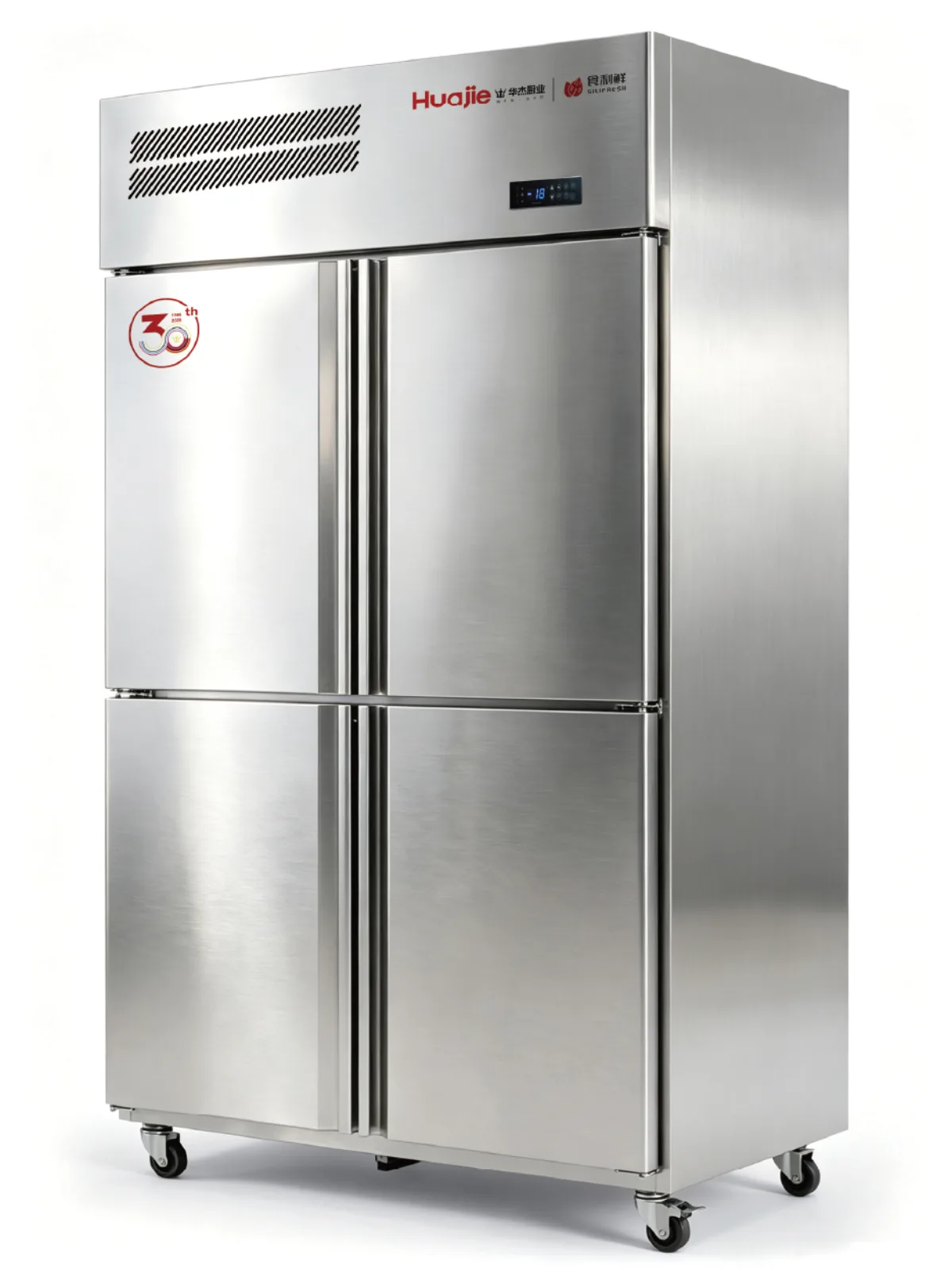
Export freezer after-sales complaints cluster around three failure modes: temperature mapping drift, defrost peak overshoot, and nameplate mismatches. This article uses the Microseismic Fresh HY-MWCR-C4F as a working example and breaks down the seven hard gates of a freezer FAT.
Why FAT Inspections Stall on Export Commercial Freezers
Over the past twelve months we logged 23 export after-sales cases from nine countries on commercial upright freezers. Six out of ten complaints cluster around three failure modes: temperature mapping drift (4-6 deg C gradient front-to-rear), recovery time exceeding 25 minutes after a door-open cycle, and defrost peak overshoot above 12 deg C. From purchase order to FAT acceptance, a four-door commercial freezer typically runs 6-8 weeks - and most of the trouble shows up at the acceptance step, when the buyer's site team finally meets the unit and notices that the temperature zones, defrost curve, and nameplate ratings don't line up with what the quotation promised. This article uses the Microseismic Fresh four-door freezer (HY-MWCR-C4F) as a working example and breaks down the inspection points that most often trip a buyer on site.
Tracing Temperature Mapping Drift to Probe Layout
Temperature mapping drift almost always starts with probe placement. Under NSF/ANSI 7-2024 and GB/T 8059.4-2024 guidance, an upright commercial freezer needs a minimum 9-point mapping grid: front-top-left, front-bottom-left, front-top-right, front-bottom-right, middle-top, middle-bottom, rear-top-left, rear-bottom-left, rear-bottom-right, with probes fixed 5 cm off the interior rear wall. Under empty load, with the cabinet target at -18 deg C or below, the maximum spread across all nine probes after stabilization must stay within 2 deg C for the cabinet to pass. Two field failure modes show up repeatedly:
- The defrost probe is taped against the evaporator return line. When the buyer re-runs mapping, defrost happens to fire mid-test, four of the nine probes spike by +-5 deg C, and the buyer's team concludes the freezer is faulty when the cabinet itself is fine.
- The door gasket is damaged in transit. With the door closed, a 3 mm gap shows up at the gasket edge, and the front-to-rear spread stays at 3 deg C or higher once the unit stabilizes. The fault is not the refrigeration circuit - it is logistics damage and a gasket that should have been replaced before FAT.
Recommended pre-FAT routine: run the unit empty for at least 24 hours, perform three door-open cycles during that window, hold each door open no longer than 30 seconds, and verify the recovery slope returns to the target temperature at 0.8 deg C per minute or steeper.
Verifying Refrigerant and Electrical Nameplates
Nameplate mismatches are the single most common customs holdup for export freezers. A four-door unit marked CE arrives in Saudi Arabia, customs opens the crate, and the refrigerant label does not declare a GWP value - the shipment sits at port. The standard Microseismic Fresh HY-MWCR-C4F ships with R290 (propane, GWP = 3, ODP = 0) and the nameplate carries both SASO and IEC 60335-2-89 marks, so the same crate clears EU and Gulf markets. What frequently happens instead: the buyer orders the unit, receives it with the older R404a nameplate (GWP = 3921). EU F-Gas Regulation 2024 revision now restricts R404a in new equipment, and Gulf GSO is tightening similar rules. The refrigeration cycle may run fine, but the paperwork will not.
On the electrical side, three configurations must not be mixed: 220-240 V / 50-60 Hz single-phase, 220 V single-phase, and 380 V / 50 Hz three-phase. HY-MWCR-C4F offers all three as factory options. The most common field complaint: the buyer terminates 220 V single-phase to a unit wired internally for 380 V three-phase, because the factory jumper was left on the wrong terminal block. The compressor trips on first start and the buyer's electrician blames the supplier. Always confirm nameplate voltage matches the on-site supply before energizing.
Planning Defrost Cycles and Drain Routing
Defrost control is where most commissioning engineers lose sleep. Microseismic Fresh ships with electric defrost as standard: one cycle every six hours, each cycle no longer than 20 minutes. The cabinet temperature is allowed to climb during defrost, but the peak must stay within 12 deg C - that is the hard ceiling under GB/T 8059.4-2024 and most HACCP acceptance schemes. The recovery slope after defrost must return to target at 0.8 deg C per minute or steeper. These two lines are non-negotiable on every project we supervise.
Drain freeze-ups cluster in three places: missing insulation on the drain line, heater tape rated below 30 W per meter, and a clogged drain screen that was never cleaned. On site, verify the drain line is wrapped in 19 mm rubber-plastic insulation with no gaps, the heater tape is continuous without cold spots, and the drain screen is removed and cleaned every two weeks. For FAT, run the unit continuously for at least 72 hours, pour 500 mL of room-temperature water into the drain pan, and confirm the drain evacuates the full volume within 10 seconds.
FAT Checklist: Seven Hard Gates Plus Four Recommended Items
The full FAT checklist we use on site, condensed for the buyer's QA and SQE teams:
| Item | Threshold | Method | Status |
|---|---|---|---|
| Temperature mapping spread | less than or equal to 2 deg C (empty, stabilized) | 9-point data logger, more than 24 h | Hard pass |
| Defrost peak temperature | less than or equal to 12 deg C | Data logger interval less than 30 s | Hard pass |
| Recovery slope | more than or equal to 0.8 deg C/min | Post-defrost curve regression | Hard pass |
| Door-open cycle | 30 s open x 100 cycles, recovery less than 5 deg C | Continuous cycle test | Hard pass |
| Compressor inrush current | less than or equal to 5x rated current | Clamp meter | Hard pass |
| Insulation resistance | more than or equal to 1 MOhm (500 V megohmmeter) | L/N-PE test | Hard pass |
| Earth continuity | less than or equal to 0.1 Ohm | Earth resistance tester | Hard pass |
| Nameplate refrigerant | R290 / GWP less than or equal to 3 | Visual | Hard pass |
| Noise level | less than 55 dB(A) at 1 m | Sound level meter | Recommended |
| Drain flow | 500 mL in 10 s | Visual pour test | Recommended |
| Door gasket seal | Gap less than 2 mm | Feeler gauge | Recommended |
| Energy label | EU label / China energy grade | Visual | Recommended |
Sparing Kit and Field Emergency - Five Items to Ship with the Unit
After a four-door freezer is exported, what the buyer's site team fears most is not a machine failure but slow after-sales response. A small sparing kit shipped in the crate will cover roughly 80 percent of post-shipment service calls:
- Door gasket set (1 set per 4 doors) - transit damage is the most common cause; the buyer's team must visually inspect all four gaskets within 24 hours of receipt.
- Data logger batteries (CR2032 x 2) - most mapping data loggers run on coin cells, and ocean freight timelines drain them.
- Compressor relay (1 piece) - the defrost control relay is a wear item; one spare on the crate is more reliable than a vendor back-order.
- Drain screen (2 pieces) - cleaning cycle is frequent; one in service, one spare.
- Bilingual nameplate stickers (1 set) - if the buyer re-exports the unit to a third country, a clear bilingual sticker helps customs classification move quickly.
What to Do When FAT Fails - Three Field Actions in Order
When FAT does not pass, run three actions in this order before calling the supplier:
- Re-check the temperature map: first confirm probe placement follows the 9-point grid, then verify the door gasket seal, then - and only then - touch the defrost parameters. If the spread is more than 3 deg C, do not start by adjusting the controller; start by inspecting the gasket and seal.
- Re-check the recovery slope: if recovery after defrost exceeds 25 minutes, first inspect the condenser coil for dust and lint, then verify the refrigerant charge (less than or equal to 90 percent of rated is undercharged).
- Re-check insulation and grounding: with a 500 V megohmmeter, re-measure L/N-PE. If the reading is below 1 MOhm, disconnect the compressor terminal block and measure the compressor winding alone. If the winding is below 5 MOhm, recommend a full unit return.
Frequently Asked Buyer Questions
Q: Is R290 refrigerant safe in an enclosed warehouse?
A: R290 has a flash point of -104 deg C and a lower flammability limit of 2.1 percent by volume. Microseismic Fresh freezer nameplate refrigerant charge stays at or below 150 g per unit, which under IEC 60335-2-89 Annex FF qualifies as "use in well-ventilated spaces" - no flammable gas detector is required for a single cabinet installation. Twenty-four-hour mechanical ventilation in the warehouse is sufficient.
Q: The defrost peak overshoots 12 deg C but meat core temperature stays normal. Do we still need corrective action?
A: Yes. The defrost reading is cabinet air temperature, and meat core temperature lags the air reading by 30-60 minutes. HACCP acceptance is driven by cabinet air peak and dwell time, not core temperature. Any overshoot above 12 deg C is a deviation event and must be logged in the HACCP record with a corrective action entry.
Q: Can a four-door freezer be reconfigured from single-phase 220 V to three-phase 380 V?
A: Yes. Microseismic Fresh HY-MWCR-C4F ships in three factory configurations: 220 V single-phase, 220-240 V single-phase, or 380 V three-phase. The three-phase variant uses a power factor of 0.85, the single-phase variant 0.95. Before reconfiguration, verify the on-site supply capacity: at least 6 kVA for 380 V three-phase, or at least 3.5 kVA for 220 V single-phase.
Q: Will ocean freight vibration disturb the temperature mapping after FAT passes?
A: Vibration mainly affects the compressor mounting dampers and the door gasket. On arrival at port, visually inspect the gaskets first, then run the unit empty for 24 hours and re-map the temperature field. If the spread stays within 2 deg C, the unit is good to go. Microseismic Fresh units pass an 8-grade vibration test before shipment (GB/T 4857.23-2021), and on-site re-mapping pass rate after ocean transit is above 95 percent.
Conclusion
A freezer FAT is not finished when the unit is plugged in. It is finished when the unit has run empty for at least 72 hours, the 9-point temperature grid is mapped, the defrost peak is logged, and the nameplate ratings are checked. A four-door freezer that clears FAT is backed by five hard gates all passing together: 9-probe mapping plus defrost peak less than or equal to 12 deg C plus recovery slope more than or equal to 0.8 deg C/min plus door-open cycle plus insulation resistance more than or equal to 1 MOhm. Send the project capacity, site conditions, local voltage spec, and ocean route to the supplier in one package; read the MOQ, lead time, and acceptance terms in person. Final specifications depend on the selected model, project requirements, and supplier technical documents.
References
- NSF/ANSI 7-2024 Commercial Refrigerators and Freezers
- GB/T 8059.4-2024 Household and similar electrical refrigeration appliances - Refrigerating-freezing type
- IEC 60335-2-89 Household and similar electrical appliances - Safety - Part 2-89
- EU F-Gas Regulation 2024 Revision
- EN 378-1 Refrigerating systems and heat pumps - Safety and environmental requirements
- GB/T 4857.23-2021 Packaging - Basic tests for transport packages
Author: Su Tao; Shunxiang Central Kitchen, Huayi Intelligent