
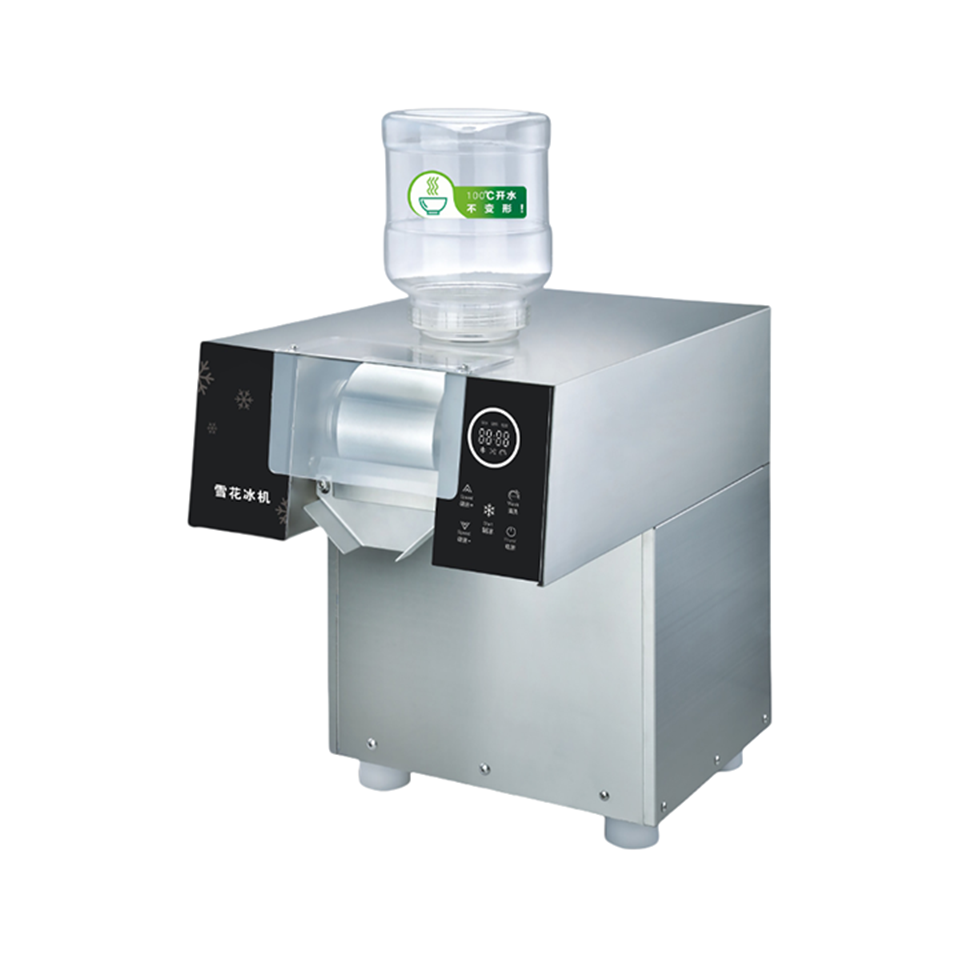
Selecting a commercial ice maker? Match ice type, capacity, cooling medium, and FAT acceptance to the operation. 2026 buyer's guide covers HY-21, HY-11, HL-26, SD-22 with 8-step protocol + 6-point FAT checklist.
Commercial Ice Maker Selection 2026: Snowflake vs Cube Capacity, Cooling Type, and FAT Acceptance (Foodservice & Cold-Chain Export Edition)
Selecting a commercial ice maker is rarely about brand — it is about matching ice type, capacity, cooling medium, and FAT acceptance to the food-service or cold-chain operation. This 2026 guide uses four reference units — HY-21 series air-cooled snowflake ice maker, HY-11 series water-cooled snowflake ice maker, HL-26 series cube / block ice maker (30-250 kg/24h), and SD-22 countertop ice maker (22-23 kg/24h) — to walk through the eight-step selection protocol and the six-point FAT checklist used by central kitchens and seafood cold-chain buyers.
1. Ice type before brand: snowflake, cube, or clear
The single most common selection mistake is choosing by brand instead of ice type. Snowflake (flake) ice sits at -5 to -8 degrees C, has a large surface area, and conforms to the surface of seafood, leafy greens, and bakery products — ideal for seafood display counters, vegetable hydration, fish pre-cooling. Cube / block ice sits at -8 to -12 degrees C, hard, clear, slow-melting, and easy to dose for beverages — ideal for drinks shops, bars, supermarket drink counters. Clear crescent / nugget ice sits between the two and fits premium coffee and tea. Pick by application, not by logo.
2. Capacity: rated daily output vs peak-shift demand
Manufacturer-rated daily output is normally quoted at 10 degrees C ambient and 15 degrees C inlet water. Export buyers in tropical ports or hot kitchen environments should derate by 20-30 percent. The HY-21 air-cooled snowflake unit is rated at 200 kg/24h; at 30 degrees C ambient, expect 145-160 kg over 24 hours. The HL-26 cube machine spans 30-250 kg/24h in six steps. Plan capacity against peak-shift demand, not daily average. For a restaurant running 200 covers per evening shift, a 60-80 kg machine covers steady state, but a 100-120 kg unit covers the 6 pm-9 pm peak without foam top-up cycles.
3. Cooling medium: air-cooled vs water-cooled
Air-cooled units use a condenser fan and need 300 mm rear clearance plus 600 mm top service space. They suit small kitchens, convenience stores, and coffee backrooms with decent ventilation. Water-cooled units use a cooling tower or chilled-water loop — COP is 15-22 percent better, but you pay for tower installation, water piping, and winter freeze protection. Export buyers in the GCC, North Africa, and Southeast Asia prefer water-cooled because ambient temperatures of 35-45 degrees C cut air-cooled efficiency sharply. The HY-11 water-cooled snowflake unit delivers 180 kg/24h at roughly 80 percent of the air-cooled electrical input.
4. Can one machine make two ice types?
No. Snowflake evaporators are vertical cylindrical scrapers running a continuous freeze-and-scrape cycle; cube evaporators are horizontal copper-tube grids with hot-gas or electric defrost. The control logic, refrigerant charge, and harvest cycle are incompatible. If a multi-store chain needs both ice types, deploy two units or pick a diced / nugget machine that fills the middle ground at 80-150 kg/24h.
5. Installation prerequisites: water, power, ventilation
Three utilities have to be right before FAT: inlet water pressure 0.15-0.5 MPa and inlet water temperature under 35 degrees C; power supply 220V/50Hz single-phase or 380V/50Hz three-phase per nameplate; ambient 5-40 degrees C and relative humidity under 85 percent RH. Air-cooled units need 300 mm rear and 600 mm top clearance. Water-cooled units need DN15 inlet and return ports and a drain. A multi-store chain installation we audited in 2025 had five units going into high-temperature alarm at FAT because no one specified rear clearance — write the prerequisites into the procurement contract annex, not just the acceptance sheet.
6. Hygiene and certifications: NSF, CE, ISO 22000
US-bound buyers expect NSF/ANSI 12-2024 (Commercial Ice Makers — Food Equipment), which covers ice-contact surface materials, evaporator corrosion resistance, and condensate drainage. EU-bound buyers need CE-EMC plus CE-LVD declarations and EU 1935/2004 plus EU 10/2011 food-contact statements. Factory-side ISO 22000 or FSSC 22000 plus HACCP for seafood lines determines whether you enter a major-chain short list. Evaporator and ice-contact surfaces should be SUS304 stainless with a 2B finish — avoid zinc-plated or aluminum alloys in direct ice contact. Domestic GB references are GB 31604.1-2015 (food-contact materials) and GB 4706.13-2014 (refrigerating appliances, ice makers).
7. Energy and water: per-ton figures
Snowflake ice makers consume 50-70 kWh per ton of ice at the condenser; cube ice makers consume 60-85 kWh per ton. Water-cooled units save 15-22 percent on ice-making electrical input but consume 5-8 kWh per ton extra at the cooling tower and pump. The SD-22 countertop unit draws about 0.18 kW-h per hour and runs 16 hours a day — daily 2.9 kWh. For cold-chain operations, calculate per-ton ice cost: a 0.8 RMB/kWh factory pays roughly 50 RMB per ton for snowflake electrical; at 1.5 RMB/kWh it climbs past 90 RMB per ton — at which point water cooling stops being optional.
8. Six-point FAT checklist (factory + site)
Commercial ice maker FAT must go beyond "power on and see if ice comes out". Six checks to walk through: (1) Ice type confirmation — snowflake / cube / clear; record three temperature readings between -5 and -12 degrees C. (2) Daily output curve — measure at hours 1, 4, 8, 12; expect within plus or minus 10 percent of nameplate. (3) Inlet water pressure and temperature — steady-state 30 minutes within plus or minus 15 percent of nameplate. (4) Condenser temperature — air-cooled 55 degrees C max; water-cooled condenser approach 8 degrees C max. (5) Hygiene material certificates — SUS304/2B evaporator and ice-contact surfaces with GB 31604.1-2015 plus NSF/ANSI 12-2024 reports. (6) Electrical nameplate match — voltage, phase, frequency, IP rating match the nameplate; CE marking traceable.
FAQ — common buyer questions
Q: Which ice type melts slower, snowflake or cube?
A: Cube. Snowflake has a large surface area; at 10 degrees C ambient, half a flake melts within 90 minutes. A cube of equal mass loses roughly 25 percent volume over four hours under the same conditions. Drinks shops running continuous service should pick cube; seafood buffets and display counters should pick snowflake.
Q: Is air-cooled or water-cooled more energy-efficient?
A: Water-cooled. Same daily capacity, water-cooled saves 15-22 percent electrical input, but cooling tower adds 5-8 kWh per ton extra. Long-run operation above 12 hours per day favors water cooling; short-run below 6 hours per day favors air cooling on capex.
Q: How do I confirm the power supply an ice maker needs?
A: Read the nameplate. SD-22 is 220V/50Hz single-phase; HY-21 is 220V/50Hz single-phase; HL-26 high-output models need 380V/50Hz three-phase. Send the supplier your site power spec (voltage, phase, frequency, capacity) and ask for written confirmation before shipping.
Q: How do you check hygiene design on a commercial ice maker?
A: Four hard checks: SUS304/2B evaporator, no zinc plating on ice-contact surfaces, automatic CIP program or removable water tray, condensate drain routed away from the ice bin. NSF/ANSI 12-2024 test report is the export-side gold standard.
Q: How does ambient temperature affect daily ice output?
A: Inversely. Every 5 degrees C rise in ambient cuts daily output by 8-12 percent. At 30 degrees C the unit delivers 70-80 percent of nameplate; at 40 degrees C it falls to 55-65 percent. Tropical-port buyers should add 25-30 percent capacity margin.
This eight-step protocol covers the full SD-22 (22 kg desktop) through HL-26 (250 kg large) spectrum. MOQ, lead time, and acceptance terms go face-to-face, not just ice type. Final specifications depend on the selected model, project scope, and the supplier's technical documentation.
Author: Su Tao; Jinan Shunxiang Central Kitchen Internet Technology, Shandong Huayi Intelligent Equipment