

A wash area is sized in plates per hour, not in litres. Convert volume to plate count, compare hot air, far-infrared and UV plus ozone, check the 220 V single-phase load, and work through eight FAT items with six current models.
Start with the plate count, not the cabinet count
Jinan Shunxiang Central Kitchen is a process design and equipment integration partner for central kitchens and food factories: process flow diagrams, line planning, building design, equipment selection, and acceptance through to production. This article covers one zone only: how many tableware sterilizers a wash area actually needs.
The quotation usually says "two sterilizers". Nobody writes a plate count. Then the units arrive and the six-compartment trays will not sit upright in the rack, the soup bowls have to be stacked on top of the plates, and a cabinet rated at 930 plates holds a bit over six hundred positions. Half the capacity was never there.
Volume in litres comes from the internal dimensions. Plate count is a theoretical figure for dense racking of one standard tray. The two numbers do not convert into each other. That is the first thing to settle.
Work out plates per hour, then back into volume
Size on the peak hour, not on the daily total divided by ten. That division always understates the requirement.
Take 8,000 meals a day on two shifts. The lunch peak sends out 60% of them within two hours, so 4,800 sets, or 2,400 sets per hour.
A five-piece set is one six-compartment tray at roughly 350×265×25 mm, one soup bowl at 110–120 mm diameter, one small bowl, and two pieces of cutlery. Use a conversion factor of 1.45 plate positions per set, because the bowl eats about a third of a position.
Loading efficiency runs 65%–75%. Rolled edges, warped trays and mixed ware types all cost positions. A 930-plate cabinet at 70% gives 650 positions, which is about 450 sets.
Allow 40 minutes per cycle: five to load, twenty-five to ramp, ten to hold. That is 675 sets per hour per cabinet, so 2,400 sets per hour needs 3.6 units and you buy four.
Run the same arithmetic on a 360 L cabinet and one unit holds about 200 positions, or 96 sets, for 145 sets per hour. You need sixteen of them. Four times the units, and the installed load is 35.2 kW against 9.6 kW, a factor of 3.7. Small cabinets are cheaper per unit, not in total.
Choose the route: hot air, far-infrared, UV plus ozone
All three are sold as sterilizers. The physics is entirely different, and mixing them on one quotation is where projects go wrong.
| Item | Hot air (XD-6 / XD-12) | Far-infrared (XD-18) | UV + ozone (XD-14) |
|---|---|---|---|
| Mechanism | Chamber air raised to 120 °C, forced circulation | Lamp radiation heats the ware surface directly | Ambient temperature, UV irradiation plus ozone |
| Temperature spread | Air wraps the racks, nested plates reach set point | Line-of-sight only, shadowed areas stay cooler | No heating, no spread to speak of |
| Loading tolerance | High, stacking and mixed ware accepted | Low, single layer with the face turned to the lamps | Medium, stacking allowed but shadows are dead zones |
| Installed power | 2.2 kW (360 L) / 4.4 kW (720 L) | 0.9 kW (360 L) / 1.8 kW (720 L) | 1.8 kW (750 L) / 3.6 kW (1500 L) |
| Cycle | 25–30 min ramp plus 10 min hold | 5–10 min to surface temperature | 30–60 min plus ozone decay |
| Ware | Stainless, ceramic, glass | Shallow stainless trays, ceramic plates | Melamine, plastic trays, knives and boards |
| Limitation | High power draw, slow ramp, hot shell | Shadowed surfaces, awkward for deep bowls | Ozone smell, must air before use |
Hot air circulation raises the whole chamber to 120 °C and moves it with a fan. Air reaches the gaps between racks, so nested plates still come up to temperature. The cost is a slow ramp: a 2.2 kW 360 L unit typically needs 25–30 minutes to take an empty chamber from 25 °C to 120 °C, and another 10–15 minutes when loaded. Verify that on the FAT. Do not quote the catalogue figure as a commitment.
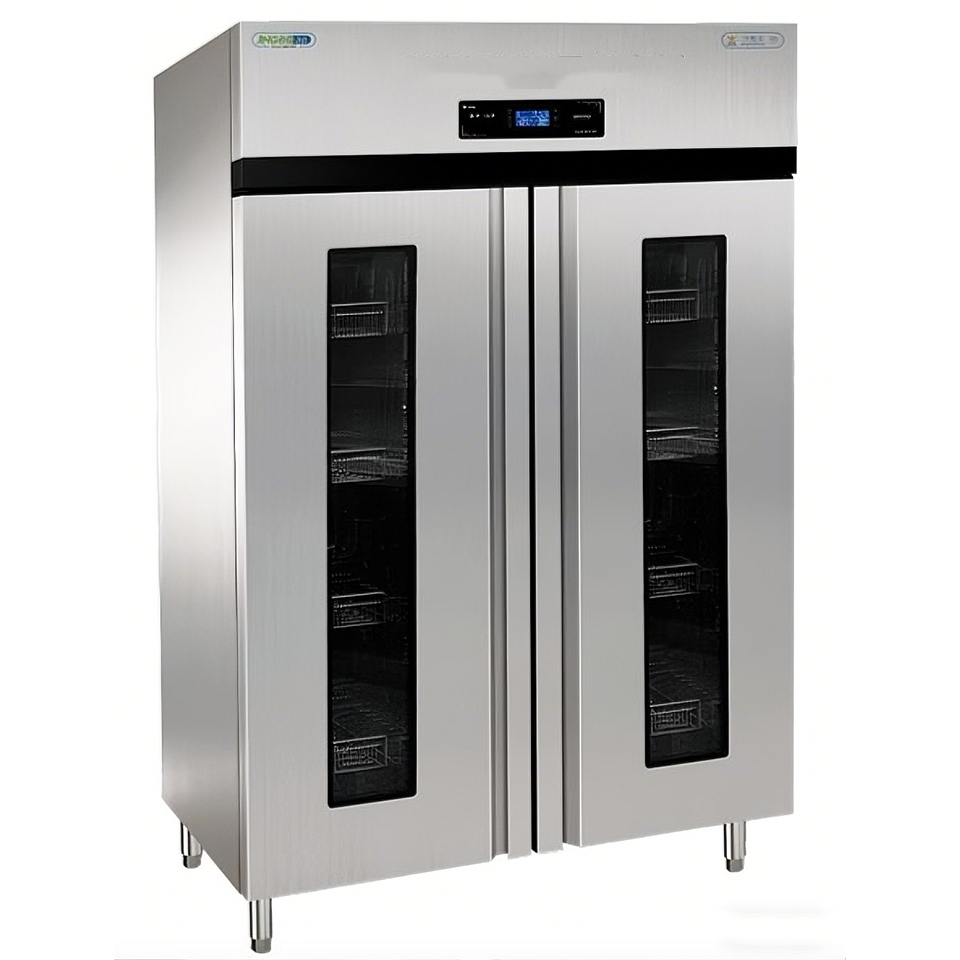
Far-infrared lamps heat the ware surface by radiation. A 360 L unit draws only 0.9 kW, which is 41% of the hot-air unit at the same volume. It reaches surface temperature in 5–10 minutes. But radiation travels in straight lines, so the inner faces of nested plates and the backs of deep bowls stay cool. Keep it to a single layer with the face turned toward the lamps.
UV plus ozone runs at ambient temperature. UV kills on line-of-sight surfaces, ozone fills the shadows. This is the route for melamine, plastic trays, knives and cutting boards that cannot take high heat. The catch is ozone decay: allow 30–60 minutes after shutdown and ventilate before unloading, or the smell follows the trays into the dining room.
The rule is short. Stainless, ceramic and glass go to hot air. Melamine and plastics go to UV plus ozone. Far-infrared is for small fast-food counters that can load a single layer.
Check the 220 V supply and the footprint
Every model in this range is single-phase 220 V. Size the circuit from the nameplate, not from habit.
| Model | SKU | Config | Volume / plates | Overall size (mm) | Voltage | Power | Method |
|---|---|---|---|---|---|---|---|
| RTP930MC-1 sliding double door | XD-17 | Double | 930 plates | 1400×630×2030 | 220 V | 2.4 kW | Hot air |
| High-temperature trolley | XD-6 | Single | 700 L | 880×830×1980 | 220 V | 2.2 kW | Hot air, 120 °C |
| High-temperature trolley | XD-6 | Double | 1400 L | 1700×830×1980 | 220 V | 4.4 kW | Hot air, 120 °C |
| Mechanical hot air | XD-12 | Single | 360 L | 660×620×1980 | 220 V | 2.2 kW | Hot air, 120 °C |
| Mechanical hot air | XD-12 | Double | 720 L | 1320×620×1980 | 220 V | 4.4 kW | Hot air, 120 °C |
| Far-infrared | XD-18 | Single | 360 L | 660×620×1980 | 220 V | 0.9 kW | Far-infrared |
| Far-infrared | XD-18 | Double | 720 L | 1320×620×1980 | 220 V | 1.8 kW | Far-infrared |
| Melamine trolley | XD-14 | Single | 750 L | 880×830×1980 | 220 V | 1.8 kW | UV + ozone |
| Melamine trolley | XD-14 | Double | 1500 L | 1700×830×1980 | 220 V | 3.6 kW | UV + ozone |
How to read the table. 2.2–2.4 kW draws 10–10.9 A, so 2.5 mm² copper on a C16 breaker is enough. 3.6 kW draws 16.4 A and sits right at the edge of 2.5 mm², so go to 4 mm². 4.4 kW draws 20 A, which needs 4 mm² on a C25, with the breaker sized at 1.25 times running current. Note also that the XD-12 and XD-18 sheets give height by width by depth, while the others give width by depth by height.
Give each unit its own circuit, 30 mA residual current protection, and a reliable earth. Put a dozen small cabinets on one circuit and a single trip stops the whole wash line.
Footprint is the item people forget. The RTP930MC-1 measures 1400×630×2030 mm, and that 2030 mm has to be checked against the ceiling void, exhaust duct and cable tray before the slab is poured. A dual-passage unit sits in the partition between the dirty and clean sides, so the wall opening belongs in the civil drawings. Cutting it afterwards is destructive renovation.
Leave at least 100 mm behind the cabinet for heat rejection. Hot-air units run a hot shell, and a cabinet pushed against the wall will cook its own door gasket.
Eight FAT items, starting with the temperature curve
Acceptance is about curves, not nameplates.
- Temperature curve: three points (top, middle, bottom) empty and loaded. Record ramp time and hold stability, and keep the spread within ±5 °C.
- Timing logic: the timer starts when set point is reached, stops and resets when the door opens. Some cabinets start counting the moment the switch is thrown, and that is the easiest item to fake.
- Full-load test: load to 100% of the rated plate count and check that the door closes, the racks do not sag, and the air path is not blocked by trays.
- Electrical: measured running current against the nameplate (2.4 kW is about 10.9 A), and a trip test on the residual current device.
- Material and welds: SUS304, dressed internal welds, no dead corners, no exposed screws, checked against GB 4806.9-2016 for food-contact metallic materials.
- Door seal and insulation: double tempered glass, gasket with no gaps, outer surface cool enough to touch.
- Disinfection performance: sample per GB 14934-2016 for coliforms, Salmonella, and anionic detergent residue.
- Documents: nameplate, certificate of conformity, wiring diagram, manual and spare parts list. Every missing item is retention money.
The heat disinfection figures are fixed: boiling or steam at 100 °C for at least 10 minutes, infrared at 120 °C for at least 10 minutes, and GB 31654-2021 carries the same requirement. Count from reaching temperature, not from throwing the switch.
Plan the dirty-in, clean-out layout in three flows
A correct cabinet in a wrong layout still jams. Separate three flows on the plan:
- Scrap line: trolleys are scraped and degreased on entry. Trays that go in with residue come out with a baked film that thickens every cycle.
- Wash line: ware leaves the dishwasher wet, so drain it before loading. Dripping into a 120 °C chamber slows the ramp and scales the element.
- Clean line: out of the cabinet and straight into storage, never back through the dirty side. This is where a dual-passage unit earns its price, because nobody has to walk back around.
Size the aisle for a trolley turning circle, at least 1.2 m. Door swing should follow the flow; sliding doors save space but need standing room on both sides.
A hotel-group central kitchen in Shandong, 11,000 m², went into production in July 2018 six months after start. In that kind of schedule the wash area is the zone that gets squeezed last, which is exactly why cabinet dimensions and wall openings have to be frozen at the civil drawing stage.
Five questions buyers actually ask
Q: How many sets does a 930-plate cabinet really hold?
A: At 65%–75% loading with five-piece sets at 1.45 positions each, roughly 420–480 sets. Have the supplier check the rack drawing against your tray first.
Q: Will 120 °C hot air damage melamine?
A: It accelerates ageing and warping. Send melamine to UV plus ozone or a low-temperature route, and take the temperature limit from the ware manufacturer.
Q: What cable does one cabinet need?
A: Single-phase 220 V. 2.2–2.4 kW takes 2.5 mm² on a C16; 3.6–4.4 kW takes 4 mm² on a C25. One circuit per unit, with 30 mA residual current protection.
Q: Can a sterilizer replace a dishwasher?
A: No. The dishwasher removes residue and grease; the sterilizer only kills. Load residue and the hot air bakes it into a film that builds up cycle after cycle.
Q: What is the difference between dual-passage and a plain double door?
A: A dual-passage unit has doors on both faces, one in the dirty zone and one in the clean zone, with the body set into the partition. A plain double door is two doors on the same side, which only doubles the volume.
Four checks before the quotation goes out
- Whose tray did you count with? Put the tray dimensions in the technical agreement, not just the volume.
- Is the peak hour a real two-hour peak, or a ten-hour average?
- Have the total installed load and circuit count gone to the electrical engineer?
- Has the wall opening for the dual-passage unit gone to the civil contractor?
As of 2026 the specification envelope is stable: single-phase 220 V, 120 °C hot air, SUS304. What keeps moving is the ware itself. Takeaway containers and compostable trays are replacing ceramic, and their temperature limits are far lower, so fix the ware before fixing the cabinet. The models in this article are listed on the sterilization cabinet category page and the full product directory.
Send the throughput, site conditions, tray specification and available supply to the supplier together, and the quotation will mean something. Final specifications should be confirmed according to the selected model, project requirements and the supplier's technical documentation.