
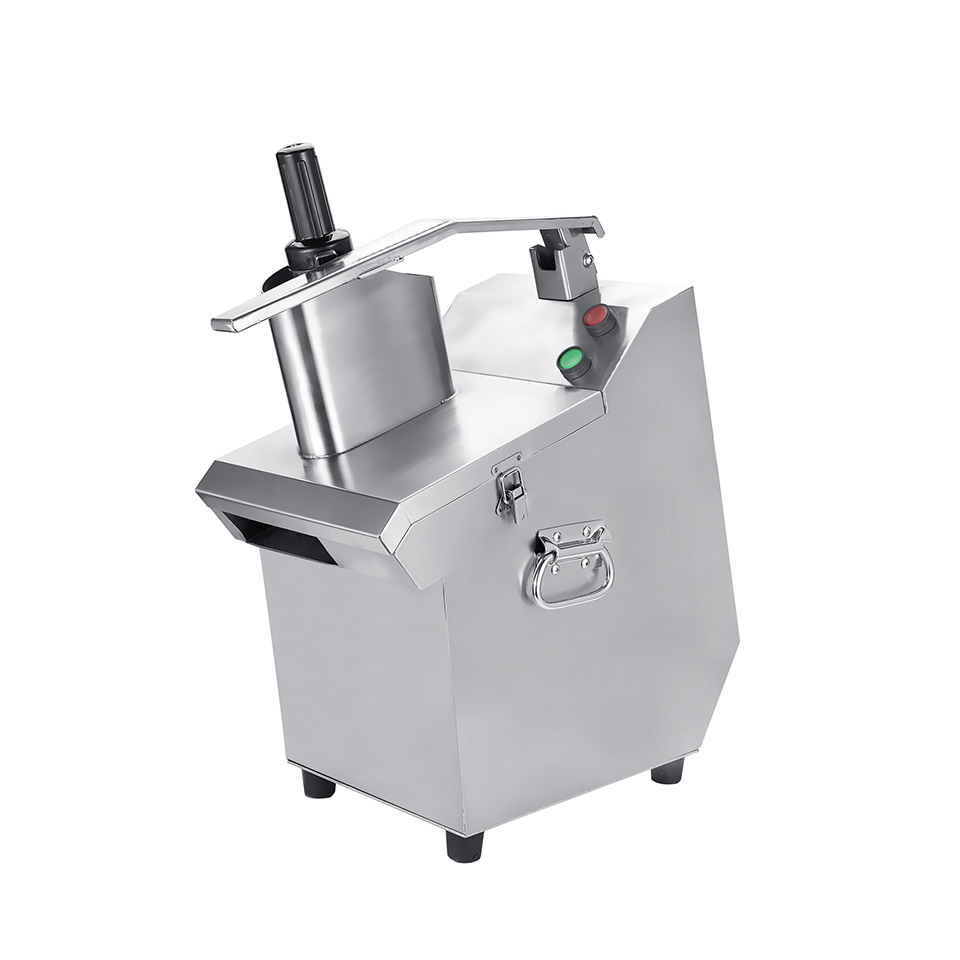
A 2026 buyer's guide to commercial vegetable dicers. Compares centrifugal vs rotary vs manual dicers, lists blade geometry, throughput, motor load, and washdown design checks central kitchens and food processing plants should run before FAT.
Why a Vegetable Dicer Matters in Central Kitchens and Food Processing Plants
Every central kitchen, school catering base, and prepared-food plant we work with has one station that quietly decides whether the day's prep hits plan: the vegetable cutting station. A commercial vegetable dicer replaces 6 to 10 hand cutters and converts bulk raw vegetables into uniform cubes, slices, or shreds before washing, blanching, or stir-frying. When the dicer drifts out of spec — dull blades, wrong cut size, motor stall under peak load — the bottleneck pushes downstream into cooking, plating, and dispatch. Throughput at the dicer usually sets the ceiling for the whole line.
Most export buyers come to us after a previous line underperformed. The complaint is rarely "the dicer broke." It is usually "we ordered 200 kg/h and only saw 110 kg/h on shift two," or "our QA rejected 14% of the cut because cubes were not uniform." Both trace back to one of three design points: blade geometry, motor torque margin, or washdown access. This guide walks through each, then closes with the FAT checklist our engineers run before signing off an order.
Three Dicer Architectures and Where Each One Fits
Commercial vegetable dicers fall into three families. The right pick depends on your vegetable mix, target cut, and cleaning cycle.
- Centrifugal dicer — high-speed disc with curved blades; throughput 300–1500 kg/h; suits potato, carrot, beet, hard root vegetables; cut range 3–20 mm.
- Rotary (drum) dicer — slow-turning drum with fixed blade grid; throughput 80–400 kg/h; suits leafy vegetables, onion, pepper, cabbage where bruising matters.
- Manual / hand-press dicer — operator-powered grid; throughput 30–80 kg/h; fits small prep stations, demo kitchens, or backup units during cleaning.
For most central kitchens running 5,000–20,000 meals/day, the centrifugal dicer carries the morning shift and a rotary dicer handles the afternoon leafy mix. Trying to push leafy vegetables through a centrifugal dicer at full speed is the most common cause of bruising and juice loss we see in audit reports.
Key Specifications Buyers Should Verify
Marketing pages emphasize throughput and motor wattage. Our engineers look at seven numbers that predict real shift performance. Treat any figure you cannot verify with a nameplate or factory test record as a negotiation point, not a guarantee.
| Parameter | Acceptable range (2026 spec) | Why it matters |
|---|---|---|
| Motor power | 200 W – 2.2 kW | Must carry 1.3× rated load at peak; undersized motors overheat and trip after 40 minutes. |
| Spindle speed | 200 – 600 rpm | Too fast = bruising on leafy vegetables; too slow = cuts degrade and the operator overfeeds. |
| Throughput | 80 – 1500 kg/h | Match to upstream washing line capacity, not theoretical maximum. |
| Cut size range | 3 – 25 mm | Cube, strip, slice, shred — confirm all grids you need are factory-supplied. |
| Hopper opening | ≥ 120 mm diameter | Smaller openings force pre-cutting, which defeats the purpose of a dicer. |
| Material contact | SUS 304 stainless steel | Required for HACCP zones; SUS 316L for salt-brine or acid wash. |
| Noise at 1 m | ≤ 78 dB(A) | Hearing protection mandatory above 80 dB; sustained 85 dB causes operator fatigue. |
Blade Geometry: The Variable Most Buyers Skip
Blade geometry decides cut quality more than motor power. Three specifications matter.
- Edge angle — 18° to 24° for leafy vegetables (sharper, cleaner cut, less bruising); 28° to 32° for hard roots (tougher edge survives bone-hard beet).
- Blade grid thickness — 0.6 mm to 1.2 mm; thinner grids give cleaner cuts but wear out 2–3× faster.
- Cutting stroke — continuous (centrifugal) vs intermittent (piston); intermittent systems produce more uniform cubes for IQF lines.
A standard mistake is to spec the cheapest blade grid because all grids look identical in catalog photos. After 40 shift hours, a 0.6 mm grid on hard carrot can fold. Our procurement check: order one extra grid set for every two units, then rotate them through your sharpening schedule.
Hygiene and Washdown Design
Central kitchen operators and food processors run washdown 2–4 times per shift. The dicer must tolerate hot water (75–85 °C), neutral detergent, and occasional chlorine spray (50–100 ppm). Three design points predict washdown success.
- Sealed bearings — IP65 or higher on the motor shaft; unsealed bearings absorb water and fail within 6 months.
- Quick-release hopper and grid — tool-free removal in under 60 seconds; if a tech needs 5 minutes with a wrench, cleaning skips happen.
- Drainage slope — base frame at ≥ 3° angle so wash water flows to a floor drain, not pooling under the motor.
Reference standard: GB 31654-2021 "National Food Safety Standard — General Hygienic Requirements for the Production of Composite Seasonings and Other Food Products" specifies hygienic construction principles that align with EU 852/2004 and FDA 21 CFR 110. Your dicer should arrive with a factory food-grade certificate and the welded-seam polishing Ra value (typically ≤ 0.8 μm on food contact surfaces).
Buyer Checklist: 12 Verification Points Before FAT
- Motor nameplate power, voltage, and frequency match your utility supply (220V/380V, 50/60 Hz).
- Throughput test report signed on YOUR vegetable mix — potato, carrot, cabbage — at the cut size you actually need.
- Blade grid set complete; spare grids and a sharpening jig included in the crate.
- Material certificates: SUS 304 (or 316L) food contact surface, gaskets food-grade silicone or EPDM.
- Noise and vibration test record at operator station.
- Electrical compliance: CE / CCC / UL depending on destination market.
- IP rating on motor housing and control box (IP54 minimum for washdown zones).
- Drainage slope verified at installation point, not just on the factory floor.
- Operator manual in destination language with cleaning sequence diagram.
- Spare parts list with part numbers — bearings, belts, gaskets, grids.
- Warranty terms (motor 2 years, gearbox 1 year, blades 90 days against manufacturing defects).
- FAT video recording showing full shift simulation — request 30+ minutes of continuous run.
Common Mistakes We See in Buyer Audits
Across 30+ dicer audits our engineers ran in 2025–2026, three mistakes show up repeatedly.
- Ordering by motor wattage alone. A 2.2 kW motor with a 200 rpm spindle will lose to a 0.8 kW motor with the right gearbox on leafy vegetables.
- Skipping the throughput test on your real vegetable. Factory tests run on carrot. Your line may run lotus root, which behaves completely differently.
- Forgetting cleaning time in the throughput math. A 1500 kg/h dicer that needs 25 minutes of cleaning between vegetable types is not 1500 kg/h — it is closer to 1100 kg/h effective.
Related Products and Categories
- Cutting & Chopping Tools — full dicer and slicer family for central kitchens and processors.
- Multi-Functional Vegetable Cutter 200W 280rpm — compact SUS 304 dicer, 200W motor, 280 rpm spindle, suited to small central kitchens and school catering.
- Professional Electric Vegetable Dicer 120W — entry-level 120W model for cafes and small prep lines.
- Manual French Fry Cutter — backup cutter for short shifts and small-volume lines.
- Commercial Ovens — downstream equipment for blanched or roasted vegetable products.
- Combi Steam Ovens — pairing for IQF vegetable lines where steam blanching precedes freezing.
FAQ
What cut sizes can a commercial vegetable dicer deliver?
Most centrifugal dicers deliver cubes from 3 mm to 20 mm, slices from 1 mm to 12 mm, and shreds from 2 mm to 8 mm. Verify the cut size range against your final dish specification, not just the catalog maximum.
How often should dicer blades be sharpened or replaced?
Daily shift cleaning extends blade life. With proper rotation between two grid sets and weekly honing, a SUS 304 blade should run 250–400 shift hours before replacement. Hard root vegetables cut life by 30–40%.
Can a single dicer handle both leafy and root vegetables?
Technically yes, but throughput drops significantly when you switch between them. Most central kitchens run a centrifugal dicer for roots and a rotary dicer for leafy vegetables to keep both at peak performance.
What is the difference between a dicer and a slicer?
A slicer produces continuous flat sheets; a dicer cuts those sheets into cubes or strips. Many machines on the market combine both functions with interchangeable grids. For central kitchens producing both salads and stir-fry, a combination unit reduces footprint and cleaning time.
What cleaning chemicals are safe for a SUS 304 dicer?
Neutral detergent (pH 6–8) for daily cleaning, hot water 75–85 °C for sanitizing, and chlorine-based sanitizer at 50–100 ppm contact time for 1–2 minutes. Avoid strong acids (pH < 3) and chlorides above 200 ppm, which will pit the stainless surface over time.
For specifications on a specific dicer model, contact our engineering team with your vegetable mix, target cut sizes, and shift throughput requirement. Final specifications should always be confirmed against your selected model, project requirements, and the supplier's technical documents before procurement.