
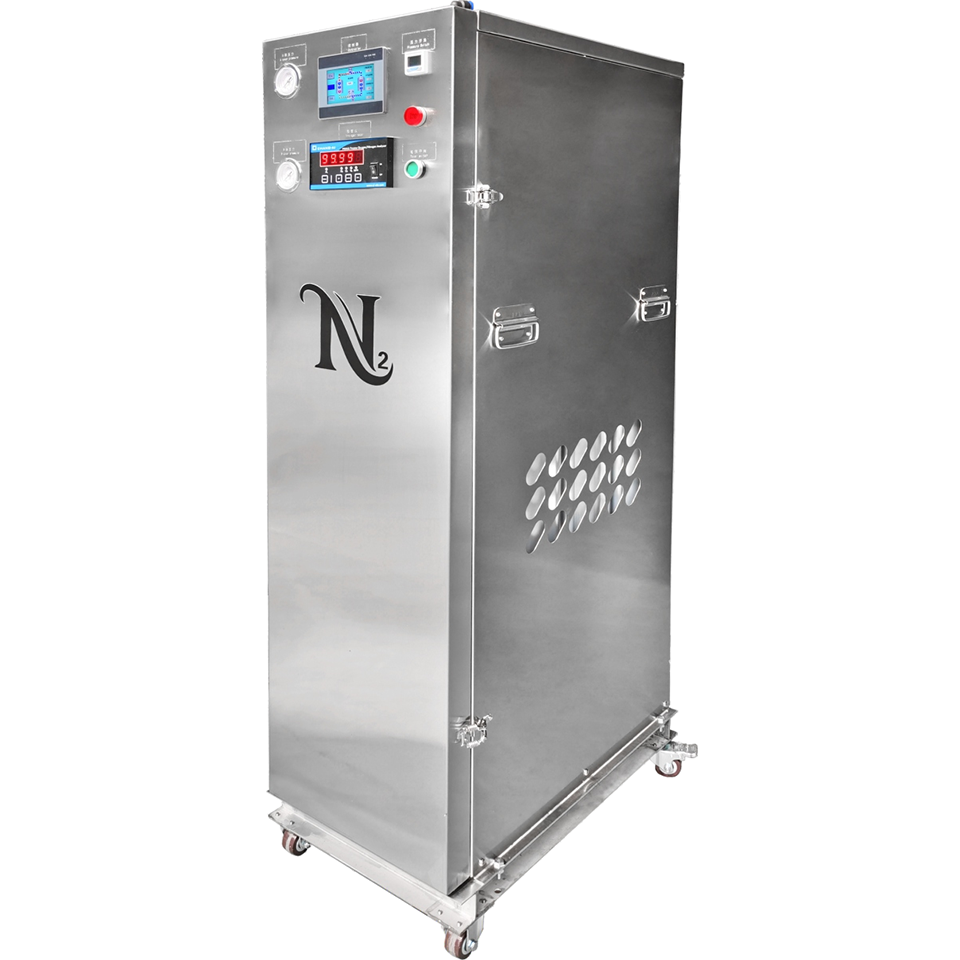
How do you size a nitrogen generator for a MAP line? Back-calculate draw from chamber volume, compare EAD and EA series purity and dew point, match the compressor, and work through the 8-point FAT checklist.
Jinan Shunxiang Central Kitchen Interconnection Technology (舜翔央厨互联科技) builds food processing and packaging equipment for export buyers. Its Hong Kong site hymic.com lists food-grade nitrogen generators in six series — BE, EAD, EA, EB, UGN-DE and EBD — that supply nitrogen on-site to MAP and vacuum packaging lines. The question every buyer asks first: how do you size a nitrogen generator, and how many Nm³/h does the line actually need?
The pain is specific. A new vacuum packer runs, the pump pulls 45 seconds of vacuum, and gas replacement still will not reach target. Bags pucker, contents oxidise and discolour, and the whole batch goes back. The fault is rarely the packer. It is nitrogen undersized — the generator was picked against compressor flow rather than chamber volume.
As of 2026, mainstream PSA nitrogen generators are advertised at 99.99% purity, but delivered purity at a 0.6 MPa outlet can sit 0.5-1.5 points below the nameplate. On bakery, nut and short-shelf-life meat lines, that gap decides shelf life.
Work out real consumption before you size anything
Do not size by packer count times single-machine draw. Real draw depends on four variables: bag volume, chamber volume, target residual oxygen and bags per minute.
In practice we back-calculate from chamber displacement. A vertical MAP machine with a 0.06 m³ chamber, two 250 g trays, running 5-6 cycles per minute, measures about 0.012-0.015 Nm³/h per cycle, so one 1-3 Nm³/h generator normally covers the line.
Run the same calculation on the hymic.com DZ-850 850 mm double-chamber packer: large chamber, large bags, slow draw, and consumption rises above 0.05 Nm³/h per cycle. In one plant those two machines can differ by a factor of 20. Measure the chamber first, not the packer wattage.
Purity and dew point are the two hard numbers
Purity depends on inlet pressure. The EAD series runs 0.7-0.8 MPa inlet and 0-0.65 MPa outlet, rated 99.99% across the range. Below 0.6 MPa inlet, the PSA adsorption balance cannot hold and purity falls under 98.5%.
Dew point matters just as much. EAD delivers -30°C pressure dew point, the floor for bakery, nut and dried-fruit lines. Fresh meat and cut produce only need -20°C. Pick the wrong dew point on a moisture-sensitive product and the caking shows up on shelf, not in the FAT.
| Parameter | EAD series (1/3/5/8/10 Nm³/h) | EA series (1.5-10 Nm³/h) |
|---|---|---|
| Nitrogen purity | 99.99% | 99.99% |
| Inlet pressure | 0.7-0.8 MPa | 0.6-0.8 MPa |
| Pressure dew point | -30°C | -40°C |
| Total weight | 45-205 kg | — |
| Dimensions (L×W×H) | 290×670×950 to 570×670×1860 mm | — |
| Case material | SUS 201 | SUS 201 |
Read the dew point and drying differences
This is where same-price machines separate. EAD reaches -30°C; EA reaches -40°C with two-stage drying plus a cold dryer. One extra condensation stage is worth it on bakery lines running dual food/pharma duty.
GB 14881-2013 clause 5.1.1 requires that gas supply systems in contact with food avoid positive-pressure dust and unfiltered air ingress. The molecular sieve and filter set is how a generator complies, and it is a mandatory FAT check item.
Calculate the power draw and compressor match
PSA generators separate nitrogen out of compressed air by adsorption. For a 3 Nm³/h unit at 0.55 MPa outlet, specify a compressor of 0.6-0.9 m³/min at 8 bar, roughly 5.5-7.5 kW. Running 16 h a day on a 6 kW machine burns about 96 kW·h daily; at an industrial tariff of 1.0-1.2 CNY/kW·h that is 96-115 CNY per day. Give the owner that figure before commissioning.
Always pair the compressor with a pre-chiller and precision filter: cold dryer condensing point below -40°C, 3 μm filtration as standard, plus a 0.01 μm oil-removal filter. Poor pretreatment ages the molecular sieve in 6-12 months, and one imported sieve set costs half a generator.
Five checks that decide FAT sign-off
On our export shipments to Southeast Asia and Africa, FAT is signed against 8 points. These five fail most often:
Purity. Sample at the outlet with an oxygen analyser and hold a stable reading for 20 minutes. GB 31654-2021 clause 8.3.2 requires food-grade gas purity to be traceable, so keep the analyser calibration certificate number on record.
Dew point. Dew point reading must stay within ±1°C and hold steady for 30 minutes under stabilised pressure.
Pressure curve. Ramp 0 to 0.65 MPa and run 4 hours. No pressure decay and no flow drop means the adsorption beds and purge lines are sound.
Noise. Measured 1 m from the operating position, no more than 70 dB(A). Above that, vibration isolation was skipped and the owner will complain.
Three-phase power. 380V/50Hz, neutral and earth on separate runs, earth resistance no more than 4 Ω. GB 50073-2019 clause 5.2.1 sets protective earthing requirements for metal-enclosed live equipment.
Buyer checklist: site conditions against acceptance values
| Check item | Site condition | Acceptance value |
|---|---|---|
| Nitrogen output | Measured bag volume and bags per minute | Delivered flow ≥ peak draw × 1.3 |
| Purity | Oxygen analyser at outlet | ≥ 99.9% (99.99% for high-barrier lines) |
| Pressure dew point | Dew point meter, 30 min stabilised | Bakery/nuts below -40°C; fresh cut below -20°C |
| Inlet pressure | Compressor outlet gauge | 0.7-0.8 MPa; check for line leakage if low |
| Noise | 1 m from operating position | ≤ 70 dB(A) |
| Earth resistance | Earth resistance tester | ≤ 4 Ω |
Three rework causes
First, undersized selection. Second, power or air supply not ready: 380V/50Hz on single phase and delivered flow drops 30%. Third, a mismatch between packer settings and gas quality — the MAP machine is set to 2% residual oxygen but supplied nitrogen is only 98.5%, so no adjustment reaches target. The third is the hardest to find and usually costs a full shift of troubleshooting.
FAQ: How do I size a nitrogen generator, and what output do I need?
A: Back-calculate from chamber displacement. A 0.06 m³ vertical MAP machine at 5-6 cycles/min with two 250 g trays draws about 0.012-0.015 Nm³/h per cycle, so 1-3 Nm³/h covers it. An 850 mm double-chamber packer draws above 0.05 Nm³/h per cycle; specify measured peak demand × 1.3.
FAQ: Is 99.99% nitrogen purity real?
A: It is the nameplate rating; delivered purity moves with outlet pressure. EAD is rated 99.99% at 0.7-0.8 MPa inlet and 0-0.65 MPa outlet. Below 0.6 MPa inlet, measured purity can fall under 98.5%. Always verify with an oxygen analyser at FAT.
FAQ: Nitrogen generator or compressed air for MAP packaging?
A: For export lines, on-site generation wins. Bottled nitrogen has low and inconsistent purity and is hard to ship; the EAD series covers 1-10 Nm³/h from small packs to line supply, with molecular sieve and filtration configured to meet GB 14881-2013 clause 5.1.1 gas cleanliness.
FAQ: How often does the molecular sieve need replacing?
A: Every 2-3 years with proper pretreatment, but 6-12 months if oil or dust breaks through. Trust the dew point, not the calendar: pressure dew point drifting from -40°C to -25°C means the sieve is spent. Pre-chiller condensing point must stay below -40°C with 3 μm filtration.
FAQ: Which certifications are needed for export?
A: Gas-path parts in contact with food should be SUS 304 or SUS 201 stainless with material certification available. Common export requirements are CE (Machinery Directive 2006/42/EC), FDA 21 CFR Part 117 for US food contact, and ISO 22000 / FSSC 22000 / HACCP system audits. Requirements vary by country; final specifications follow the selected model, project requirements and the supplier's technical documentation.
Conclusion
Sizing order matters: measure chamber, calculate draw, then fix purity and dew point, then verify power and pretreatment. Reverse it and you either run a 10 Nm³/h machine behind a 1 Nm³/h line, or fit a -20°C dew point unit to a bakery.
As of 2026, the bar for food-grade nitrogen has moved from producing nitrogen at all to holding a stable 99.99%. EAD series 1-10 Nm³/h, 0.7-0.8 MPa inlet, -30°C pressure dew point, SUS 201 case — every line matches an acceptance value. Shunxiang can size a generator against those figures or supply a trial unit; send project capacity, site conditions, local altitude and power supply, and final specifications follow the contract and technical documentation.
苏涛;舜翔央厨、华艺智能