
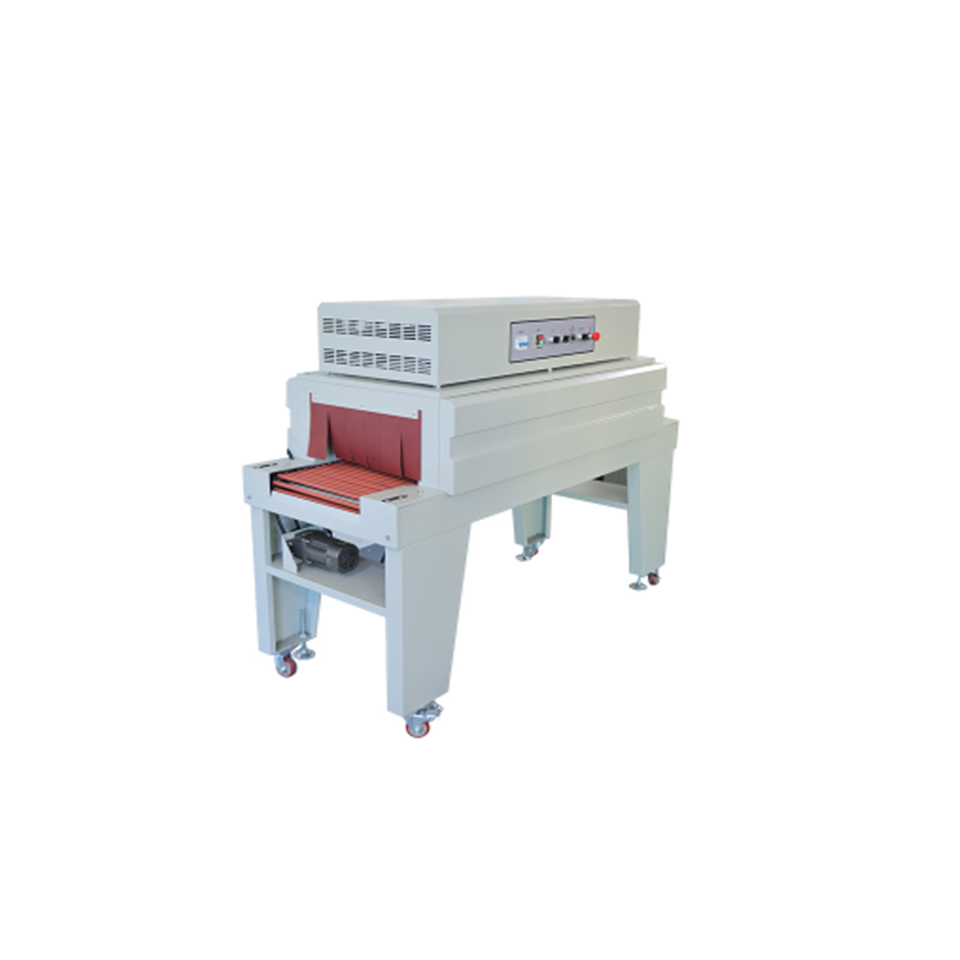
A 2026 export buyer's guide to heat shrink tunnel machines: 4522 series at 13 kW, 1300-1500 mm tunnel chamber, 100-300°C, 0-15 m/min conveyor, compatible with PVC/POF/PE films, with an 8-point FAT acceptance checklist for central kitchens and food plants.
Why Central Kitchens and Export Buyers Rely on Heat Shrink Tunnel Machines
Central kitchens ship thousands of pre-packaged meals, fresh-cut vegetable trays, sauce bottles, and meat boxes every day, and uneven shrink film is a hard reject. Across more than a decade on central kitchen projects, the shrink tunnel stage is where most owners get stuck. Wrong film, temperature drift, conveyor speed that does not match the sealer upstream, and the entire batch goes back for rework right before delivery. A heat shrink tunnel machine (Heat Shrink Tunnel) is the controlled-temperature chamber that shrinks the overwrap film tightly against the product. It runs in line with a heat shrink wrapper (L-bar sealer), but the selection logic is different.
As of 2026, when export buyers specify a heat shrink tunnel, they cannot focus on "more power is better." The tunnel chamber size, temperature range, conveyor speed, film compatibility, and maximum load all have to be checked at the same time. This article breaks down the eight FAT checks engineers actually run on the 4522 series, so export buyers and central kitchen planners can lock in the right model quickly.
1. Tunnel Chamber Dimensions: What Fits Through
Tunnel inner size (L × W × H) is the first spec. The 4522 series ships in two versions: 1300 × 450 × 220 mm (short) and 1500 × 450 × 220 mm (long). The 50 mm length difference maps directly to single-box versus twin-box layouts. The 220 mm height sets the maximum product height — single meal boxes (60-80 mm tall), double-tier gift boxes (120-150 mm), bottled sauces (70-90 mm diameter) all fit; gift boxes above 180 mm typically need a different model or a re-oriented feed.
During acceptance, run a real product through. A 300 × 200 × 60 mm ready-meal box placed at tunnel centerline should shrink evenly with no corner wrinkles. The shrink force concentrates in the heating zone, with 30-50 mm transition on each end, otherwise the film "pops" the moment it exits.
2. Temperature Range: 100-300°C Mapped to Film Type
The 4522 series covers 100°C – 300°C, supporting three mainstream shrink films:
- PVC film: 120-160°C shrink window; lower melt point, but yellows and cracks if overheated.
- POF film: 130-180°C shrink window; food-grade compliant, the mainstream choice in Europe and North America.
- PE film: 160-220°C shrink window; typical 40-80 μm thickness, common for industrial packs.
On real lines, the most common failure we see is operators pushing PE film at 280°C and above. The film punctures and the seal area deforms. The correct procedure is to confirm film grade and thickness, then set the temperature to the supplier's shrink curve, with ±10°C as the operating buffer. The temperature sensor must sit close to the conveyor surface (not the tunnel wall), within 50 mm of the belt, so it reads the actual product temperature, not the wall.
3. Conveyor Speed: Match the Sealer Upstream
The 0–15 m/min conveyor range is wide, but the actual production speed depends on the upstream L-bar sealer's cycles per minute. If the sealer is 20 boxes/min at 400 mm box length, the conveyor only needs 8 m/min to keep up. If the upstream is a twin-row sealer at 40 boxes/min, the conveyor must run at 12-15 m/min, and the tunnel chamber must be the 1500 mm version so heat soak time is sufficient.
Too fast and the film has no time to shrink; too slow and the film over-cures and becomes brittle. The verification method: lay a simple dwell-time ruler at the tunnel exit and measure how long the film sits inside the heating zone. POF film wants 5-8 seconds, PE film 8-12 seconds, PVC film 4-6 seconds.
4. Maximum Load 15 kg: The Conveyor Weight Boundary
The 4522 series is rated at 15 kg maximum load. This is the long-term limit before the conveyor belt deforms. Export buyers often miss this spec. Heavy products (ceramic gift bottle packs, five-pack beverage wraps) running slow through the tunnel wear the drive rollers and raise motor load within six months. For heavy packs, specify stainless-steel reinforced rollers or add a secondary conveyor instead of forcing standard tunnel use.
5. Film Shrink Ratio: 30%-70% and Symmetry
The 4522 series supports 30%–70% shrink ratio, which is the film property, not a machine capability. The acceptance test uses a 100 × 100 mm standard film sample, runs it through the tunnel, and measures the post-shrink dimensions. A biaxially-oriented POF film typically lands at 48% machine direction, 52% transverse direction. Symmetry error must stay under 5%. Anything wider means uneven temperature distribution inside the tunnel, and the hot-air circulation fan balance needs adjustment.
6. Mechanical Temperature + VFD Speed: Robust but Needs Calibration
The 4522 series uses mechanical temperature and speed control, not PLC plus touchscreen. This design is reliable and easy to service, but tuning accuracy depends on manual calibration. New machines should run a full thermal sweep: place temperature loggers at tunnel entry, mid-section, and exit, record empty-bench and loaded curves, and adjust the hot-air baffles if the delta exceeds ±15°C.
7. Line Integration: Electrical Interface with the Sealer
The most common export pitfall is voltage and frequency. The 4522 series runs 380V / 50Hz as the factory standard. Shipping to Japan, the United States, or Canada requires confirming voltage (200V / 208V / 220V / 240V) and frequency (50Hz / 60Hz). The tunnel must also interlock with the upstream sealer: when the sealer stops, the tunnel slows down but does not stop; when the tunnel alarms, the sealer pauses immediately. This interlock has to be validated during FAT, not patched in after the machine arrives at the customer site.
8. FAT Acceptance: 8-Point Checklist
- Tunnel chamber inner dimensions measured vs. spec, error < ±5 mm
- Temperature range empty-bench test at 100°C / 150°C / 200°C / 250°C / 300°C, ramp curves recorded
- Conveyor speed 0-15 m/min fully linear, no gear skipping
- Full 15 kg load for 30 minutes, motor current stable, temperature rise < 10°C
- PVC / POF / PE films, 50 cycles each, no perforation and no embrittlement
- Tunnel entry/exit temperature gradient logged, delta < ±15°C
- Interlock test with upstream sealer: emergency stop response < 2 seconds
- CE / UL electrical certification documents complete, voltage and frequency matched to destination market
Frequently Asked Questions
Q1: Are a heat shrink tunnel and a heat shrink wrapper the same machine?
No. The wrapper (L-bar sealer) handles film wrapping and sealing; the tunnel handles the controlled heating that shrinks the film. They run in line but perform separate functions. When the sealer stops, the tunnel does not stop. When the tunnel alarms, the sealer jams.
Q2: Can POF and PE films run on the same machine?
Yes, but the temperature setpoint must change between batches. POF runs 130-180°C, PE runs 160-220°C. On film change, allow a 10-minute cool-down to avoid blistering at the transition temperatures.
Q3: Is 13 kW power consumption high for a heat shrink tunnel?
Mid-range. At 16 hours/day and 0.6 RMB/kWh, annual electricity cost is around RMB 46,000 per machine. Export buyers can recover 15-20% of that energy by routing the tunnel's exhaust warm-up air to the packaging hall HVAC loop.
Q4: Can the 4522 tunnel length be customized?
Yes. Most OEM suppliers support non-standard 1300-2000 mm lengths, but custom builds take 45-60 days and cost 20-30% more. Orders below 50 units are usually better off with the standard catalog size.
Related Products
- 4522-15 Heat Shrink Tunnel Machine, 1500 mm, 13 kW — the model this article covers
- 600 mm External Vacuum Sealer — upstream vacuum sealing stage before shrink wrapping
- DF250TA Automatic Tray Sealer — pre-packaged meal tray sealing line
- Filling and Sealing Machine Collection — full liquid and sauce filling-sealing solutions
- 3-Door Upright Commercial Refrigerator — ready-meal cold-chain support
This article is compiled by the Su Tao / Shunxiang Central Kitchen & Huayi Equipment engineering team based on FAT testing of the 4522 series. Final specifications should follow the selected model, project requirements, and supplier technical documents. For detailed parameters and quotations, contact the hymic.com commercial team (email sxzycfcy@163.com, phone 18560135886).