

How to size a vacuum meat tumbler: 180 L drum, 1.3 kW total, -0.085 MPa vacuum, 7-8 rpm, 60%-70% load rate, realistic batch cycle and eight FAT acceptance items.
What this machine actually changes
Jinan Shunxiang Central Kitchen is a process design and equipment integration partner for central kitchens and food factories: line planning, equipment selection, delivery and acceptance. This article is about the vacuum meat tumbling machine — the unit that replaces "soak it in a tank and wait" with "tumble it under vacuum". It is written for the engineer who is laying out a marination section and about to run a prepared-dish or ready-meal line.
Static brining relies on salt diffusion. A 5 cm pork chop soaked overnight still reads pale at the centre. Tumbling lifts the meat, drops it, and presses pieces against each other. Fibre gaps open and reopen, and brine moves in along those gaps. Vacuum adds a second path: with the drum pulled down to −0.085 MPa, gas inside the meat is evacuated and the tissue draws brine back in as it re-expands. Stack the two and marination drops from 10+ hours to 1–3 hours.
So the value is not that the drum turns. It is that marination stops being a block of cold-room time and becomes a controllable process step.
Sizing: 180 L is not 110 kg per hour
Two numbers on the DGR-180 datasheet get misread most often: 180 L drum and ≤110 kg loading. The 110 kg is what goes into the drum per batch, not throughput. Mix the two up in a procurement meeting and the whole line cycle will be wrong.
Load at 60%–70%. At a full 110 kg the pieces cannot turn over; the drum just drags them along the wall and uniformity drops. Run 70–80 kg per batch for steadier results.
Then work out the batch cycle: 5–10 min loading, 20–40 min tumbling per segment (rotate/pause alternating), 10–15 min discharge and washdown. That is 45–65 min per batch. An 8-hour shift minus handover and cleaning gives 6.5–7 productive hours, so 7–9 batches, or 500–800 kg per shift.
That figure is the sizing basis. To reach 1.5 t per shift, one 180 L unit is not enough — either two units side by side, or move up to a 500 L class machine. Throughput does not come from pushing every batch to the 110 kg limit.
Matching vacuum level to tumble time
−0.085 MPa with 7–8 rpm is a "slow rotation, deep vacuum" combination. It suits whole pieces and bone-in products: ribs, whole chicken, whole duck, beef brisket cuts. Low speed means gentler impact, so shapes survive, and bone ends do not dent the drum wall.
Do not tumble continuously to the end point. Twenty minutes on, ten minutes off beats two hours straight: during the pause, brine has time to migrate inward. Time is settable from 0 s to 12 h with segment programming, so night-shift tumbling and morning discharge is workable.
Temperature is a hard limit. Hold the marination room at 0–4 °C and keep core temperature at discharge below 7 °C. Mechanical work adds 1–2 °C. When summer room temperature cannot be held, shorten each segment and add pauses rather than let core temperature drift.
Specifications: DGR-180 at a glance
| Item | Value | What to check on site |
|---|---|---|
| Model / SKU | DGR-180 / HC-32 | Quotation, nameplate and documents must match |
| Drum capacity | 180 L | Use 60%–70% of it |
| Loading capacity | ≤110 kg | An upper limit, not a recommended load |
| Vacuum degree | −0.085 MPa | Hold 10 min, watch pressure decay |
| Drum speed | 7–8 rpm | Tachometer reading, no "approximately" |
| Time setting | 0 s – 12 h | Run the full range once to auto-stop |
| Drum motor / vacuum pump | 0.55 kW / 0.75 kW | 1.3 kW total |
| Power supply | 380 V 50 Hz | Three phase; confirm incoming capacity |
| Dimensions | 1380 × 840 × 980 mm | Allow clearance for lid opening and washing |
Custom voltage, material and drum volume must be written into the contract item by item. Final specifications are subject to the selected model, project requirements and the supplier's technical documents.
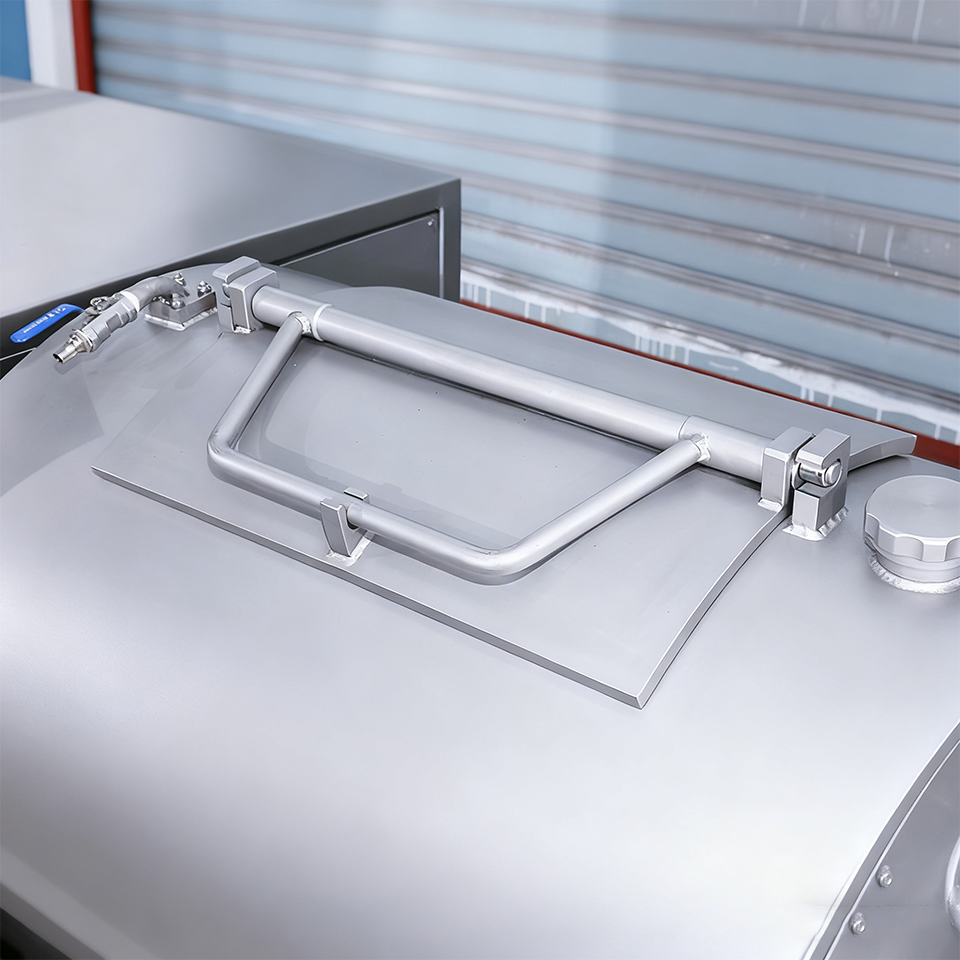
Shut the pump off and watch the gauge. That is the fastest seal test. A lid that is not clamped tight will let vacuum creep back on its own.
Comparison: three marination routes
| Route | Time to full cure | Uniformity | Best for | Investment / footprint |
|---|---|---|---|---|
| Static tank brining | 8–16 h | Poor, pale centre | Small batches, trials | Low, but ties up cold room and tubs |
| Vacuum tumbling | 1–3 h | Good, consistent within batch | Whole cuts, bone-in, poultry | Medium, 1.3 kW per unit |
| Injection + tumbling | 0.5–2 h | Best, injection rate is measurable | Thick cuts, ham-type products | High, plus injector and brine plant |
The rule is simple: pieces under 5 cm and modest volumes — tumbling is enough. For ham with a traceable injection rate, or thick beef shank, start with an injector and finish in the tumbler.
Running cost: what it draws in a day
A 0.55 kW drum motor plus a 0.75 kW vacuum pump is 1.3 kW total. The pump only runs to set point during tumbling; at 60% duty that is roughly 6.2 kWh per 8-hour shift. That is negligible inside a full line. The real cost sits in cold-room refrigeration for the marination area.
Equipment utilisation deserves more attention: hot-chain student meal central kitchens typically run at only about 30%. Static brining consumes cold-room area and tubs. In the other direction, extending shelf life so deliveries move from once or twice a day to every second day, combined with balancing logistics, has cut non-essential investment by around 60%. The hours a tumbler saves directly decide how much cold room you build.
Reference projects: Yantai Zhongtian Yuanda at 28,000 meals per day; the 11,000 m² hotel central kitchen built and commissioned in six months; the 11,000 m² Jianerjia project commissioned in 18 months and HACCP certified. What these share is not expensive equipment — it is cycle times that line up. Marination stalls, and everything downstream waits.
FAT acceptance: eight items, one by one
1. Vacuum hold: pull to −0.085 MPa, stop the pump and wait 10 minutes; pressure decay under 0.005 MPa. Soap-test the fittings and shaft seal for bubbles.
2. Speed: measure empty and loaded, both within 7–8 rpm. Use a tachometer, not the panel display.
3. Timer: set 20 minutes and confirm auto-stop; test both ends of the 0 s–12 h range.
4. Material: food-contact surfaces in stainless steel; request composition and migration test reports to GB 4806.9-2016. Welds ground smooth, no product traps.
5. Hygienic design: check internal and lid structure against GB 14881-2013 clause 5.2, cleanability against clause 6.2. Lid opens fully, drum drains without standing water.
6. Cleaning: run one full cleaning cycle per GB 31654-2022 equipment cleaning requirements; open the lid gasket and inspect for residue.
7. Electrical: 380 V / 50 Hz three phase, reliable earthing, RCD trips correctly; control box at least IP54.
8. Full load and safety: tumble 110 kg for 30 minutes; emergency stop works, castors lock, guards stay put.
Fail any one item and do not sign. Eight out of ten tumbler faults trace back to seals and the vacuum pump — catch them at incoming inspection, not after the line stops.
It is not a stand-alone machine
Upstream: bone saw and cutting; thick cuts go through brine injection first. Downstream: vacuum or MAP packaging, then blast freezing or vacuum cooling. Tub flow, washdown routes and floor drainage have to be planned with the machine. Drop one unit into an existing room and it jams within three months.
Follow the site catalogue for the full chain: vacuum tumbling machines, meat mixers, meat grinders, bone saws. For how the pre-processing section is laid out, see the bone saw selection guide.
FAQ
Q: How much meat fits in a 180 L drum?
A: Rated loading is ≤110 kg. In practice load 60%–70%, so 70–80 kg per batch. That leaves room for the pieces to turn over, which is what makes curing even.
Q: Is −0.085 MPa enough, or should we go deeper?
A: Enough for small and medium batches. Going deeper buys little in curing speed but lengthens evacuation time and shortens pump service life. Load rate, drum speed and segmented tumbling matter more.
Q: How long should one batch tumble?
A: Typically 20 minutes on, 10 minutes off, for 1–3 hours total. Bone-in and whole poultry take the upper end; thin slices and small dices the lower. The timer covers 0 s–12 h, so segmented schedules are fine.
Q: Can ribs, whole chicken and duck go in together?
A: Yes, but control the load and speed. Mixed loads with many bone ends should run 10%–20% lighter to keep bone tips off the drum wall.
Q: How is it cleaned each shift?
A: Rinse, brush the drum wall and lid, sanitise, air dry. Remove and inspect the gasket every shift; replace it at any sign of deformation or residue. Keep the cleaning log — SC audits ask for it.
As of 2026, the 180 L class vacuum tumbler is still the workhorse in central kitchens and prepared-food plants, and the selection logic has not changed: fix batch size and cycle time first, then drum volume and unit count, then talk price. Send project capacity, product form, site conditions and local power specification to the supplier together, and read the quotation and acceptance terms face to face.
苏涛;舜翔央厨、华艺智能 (Su Tao; Shunxiang Central Kitchen, Huayi Intelligent Equipment)